
From seismic events in Venezuela and Middle East diplomatic pressure to a surging dollar, record tech earnings, an AI intellectual property dispute and the FIFA World Cup 2026 breaking betting records — here is what is moving markets and shaping policy in Washington and beyond

📅 June 25, 2026🖊 ACT News International🌍 English Edition — USA / CAN
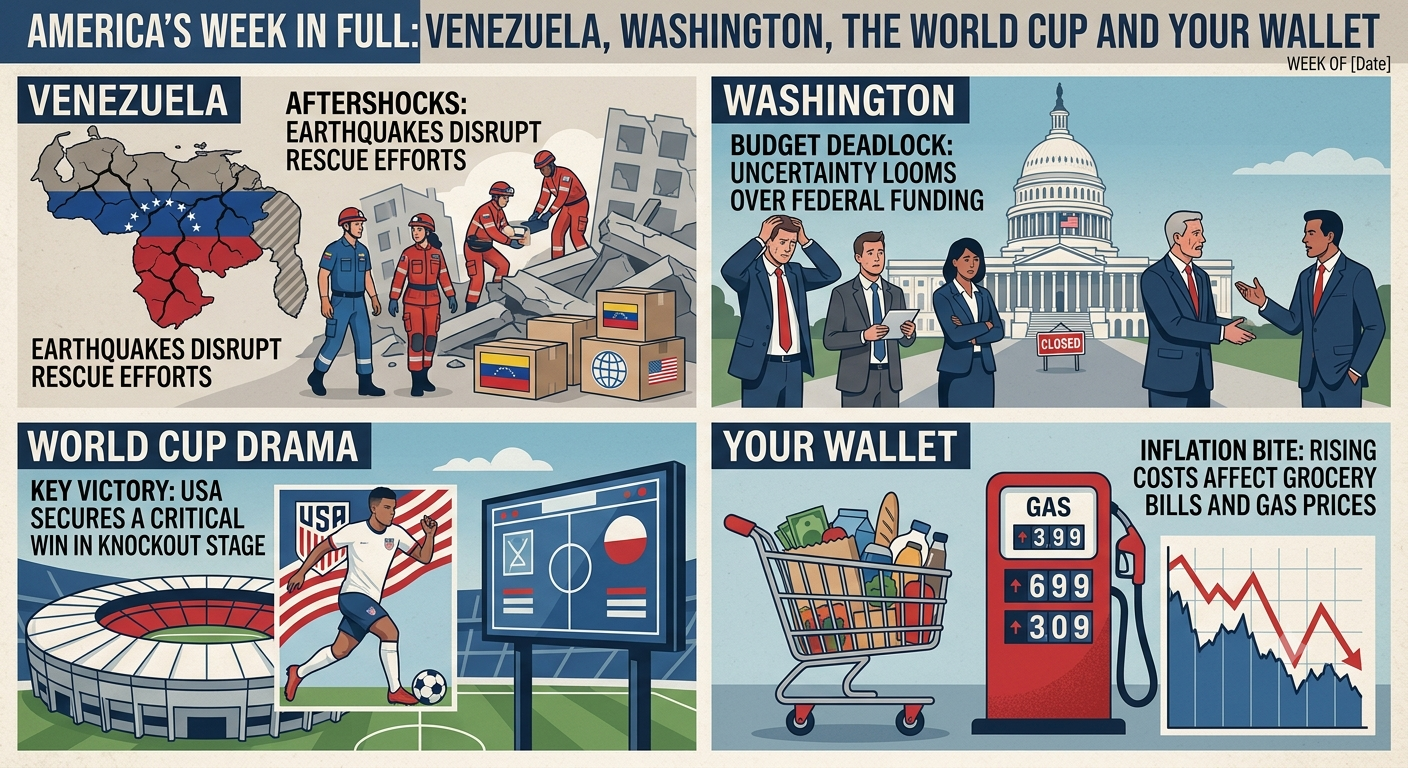
ACT News — American households and investors are navigating one of the most densely packed news cycles of the summer. On Wednesday, two high-magnitude seismic events struck near Caracas, Venezuela, within seconds of each other, leaving at least 164 confirmed fatalities and hundreds of people requiring urgent medical attention, according to preliminary figures from Venezuelan authorities that remain subject to revision. Rescue teams are still working through the rubble of collapsed structures as the government declared a state of emergency. Back in Washington, the White House is simultaneously pushing Congress for tens of billions of dollars to fund ongoing operations in the Middle East — a request that is already running into resistance from within the Republican Party itself.
Context
The seismic events in Venezuela represent one of the most significant humanitarian episodes in Latin America in recent years. The U.S. Geological Survey had previously warned that the human toll from events of this magnitude could reach into the thousands. Venezuelan Vice President Delcy Rodríguez formally declared a state of emergency, and international response teams are coordinating with local rescue personnel. For American citizens and the roughly 200,000 U.S. passport holders estimated to reside in or frequently travel to Venezuela, the State Department has activated emergency communication protocols. A large Venezuelan diaspora community across Florida, Texas, and New York is closely monitoring developments.
Meanwhile, Secretary of State Marco Rubio is on a diplomatic tour of the Middle East, where he has stated that any agreement reached with Iran will be structured to guarantee the security of Gulf allies. President Trump, however, faced pointed criticism from fellow Republicans in a closed-door Senate session over the cost and scope of military operations in the region — a rare internal clash that signals the administration’s path to securing supplemental defense funding will not be straightforward. According to reporting confirmed by multiple international outlets, the White House is requesting tens of billions of dollars from Congress for the conflict, a figure that analysts note would represent one of the largest supplemental defense appropriations in recent U.S. history.
“The potential deal with Iran could leave a key regional ally as the biggest geopolitical casualty of the negotiations,” analysts cited by international press noted — a dynamic that is already being priced into energy futures markets.
Economic impact
For American consumers and investors, the most immediate market signal this week is the dollar’s rise to its highest level in 13 months. A stronger dollar cuts both ways: it reduces the cost of imported goods at a time when CPI pressure remains a concern for the Fed, but it also squeezes the overseas earnings of S&P 500 multinationals and tightens financial conditions for emerging market economies that hold dollar-denominated debt. The bond market is currently pricing in interest rate increases that many economists believe the Federal Reserve will never actually deliver — a disconnect that is generating volatility across asset classes and creating uncertainty for American 401(k) holders and institutional investors alike.
On the tech front, Micron Technology delivered quarterly results that beat Wall Street consensus estimates, announcing $22 billion in customer commitments for AI-oriented memory chips. The report provided a significant boost to the broader semiconductor sector, lifting Nasdaq-listed names and easing concerns that the AI capital expenditure cycle might be losing momentum. For American households with index fund exposure — which now covers the majority of retirement savings accounts in the U.S. — Micron’s results reinforce the case that AI-driven earnings growth remains a durable theme heading into the second half of 2026.
In a separate technology development with significant implications for U.S. competitiveness, Anthropic has formally accused Chinese tech giant Alibaba of illicitly extracting capabilities from its Claude AI model through fraudulent accounts. The case, confirmed by multiple sources including the BBC and Reuters, is being closely watched by policymakers on Capitol Hill who are debating stronger intellectual property protections for American AI companies operating in international markets. The outcome could influence upcoming legislation on AI governance and technology export controls.
Energy and geopolitics
Crude oil prices have fallen back to levels recorded before the onset of the high-complexity regional situation in the Middle East, as signs emerge that maritime traffic through the Strait of Hormuz — a chokepoint through which roughly 20% of global oil supply flows — is gradually recovering. For American drivers, lower energy prices at the pump would offer meaningful relief, and the move in crude futures has already softened the inflation outlook at the margin. However, analysts caution that any shift in the diplomatic environment could reverse this trajectory rapidly. The ACT News team is tracking developments across multiple confirmed international sources.
Defense sector watchers in the U.S. should also note that American firm Anduril is reportedly in advanced negotiations to use former Nissan manufacturing facilities in Japan to produce unmanned aerial systems. This represents a notable shift in allied defense industrial cooperation and has implications for U.S. defense procurement, export policy, and the broader effort to diversify weapons production capacity beyond domestic borders.
Society and public services
Domestically, President Trump marked the 250th anniversary of American independence with a large-scale rally on the National Mall — drawing thousands of supporters in what the administration framed as a celebration of national heritage. The event unfolded against a backdrop of ongoing political tensions, including a public dispute between Trump and a senior Republican senator over Middle East policy, and continued fallout from federal food assistance cuts that, according to reports confirmed by Reuters, have affected millions of beneficiaries — with Arizona identified as the most heavily impacted state.
Immigration enforcement remains a live issue in communities across the country. In Minneapolis, Minnesota, residents report that the psychological impact of last year’s enforcement operations continues to shape daily life for immigrant families six months after the most intensive phase of those operations concluded. The human dimension of federal immigration policy — particularly its effects on local labor markets and public services — remains one of the most closely followed domestic stories for American readers in 2026.
On the health and wellness front, the obesity drug market is attracting fresh attention after reports that employers are scaling back coverage of GLP-1 treatments, potentially opening a window for alternative providers in the direct-to-consumer space. The market for weight-loss medications — currently anchored by Wegovy and Zepbound, with prices ranging from $800 to over $1,300 per month without insurance — is undergoing a structural shift that could reshape how tens of millions of Americans access and afford these treatments.
World Cup 2026 and consumer spending
The FIFA World Cup 2026 — co-hosted by the United States, Canada, and Mexico — is already setting records in the sports betting market, with industry projections suggesting it could become the single largest wagering event in history. For American businesses, the tournament is a major revenue driver across hospitality, broadcast rights, sports retail, and food delivery. On the pitch, Brazil advanced to the knockout rounds after a dominant showing against Scotland, with the return of Neymar generating significant media attention on both sides of the Atlantic. Mexico remained perfect with three wins from three, eliminating the Czech Republic at the Estadio Azteca, while Canada — playing in their first World Cup knockout stage in history — absorbed a narrow defeat to Switzerland but still advanced, prompting celebrations across the country. Adidas has outpaced Nike in World Cup-linked sales growth, a shift that American retail analysts say reflects the German brand’s more aggressive global marketing strategy around this tournament cycle.
Institutional analysis
Taken together, this week’s developments present a nuanced picture for American economic decision-makers. The combination of a stronger dollar, falling oil prices, and robust tech earnings creates a mixed-signal environment for the Fed — one where premature rate hikes could choke a still-fragile recovery, while holding rates too long risks reigniting inflation expectations. The geopolitical premium embedded in energy markets is easing, but the unresolved nature of the Middle East situation means that relief could prove temporary.
For investors, the Micron earnings beat and the AI investment cycle it confirms are positive leading indicators. The Anthropic-Alibaba dispute, meanwhile, underscores that the competitive dynamics of the global AI race are intensifying — and that U.S. firms are not immune to intellectual property vulnerabilities even on their own platforms. ACT News will continue monitoring all of these threads as they develop.
What to watch next
Over the next 72 hours, the key developments to track include: the pace of rescue operations in Venezuela and the potential activation of international humanitarian aid mechanisms; the outcome of Rubio’s Gulf diplomatic tour and any signals on a formal Iran framework agreement; any Fed communication that clarifies the rate path following this week’s bond market moves; and the next round of World Cup knockout fixtures, which are drawing record U.S. television audiences and generating significant advertising revenue for American broadcasters.
The Anthropic-Alibaba case is also likely to move quickly, with legal filings expected to provide more clarity on the scope of the alleged data extraction. Congressional reaction to the case could accelerate the timetable for AI-specific intellectual property legislation currently under discussion on Capitol Hill.
ACT News will continue covering all developments across these stories and their potential impact on the American economy, financial markets, and public life.