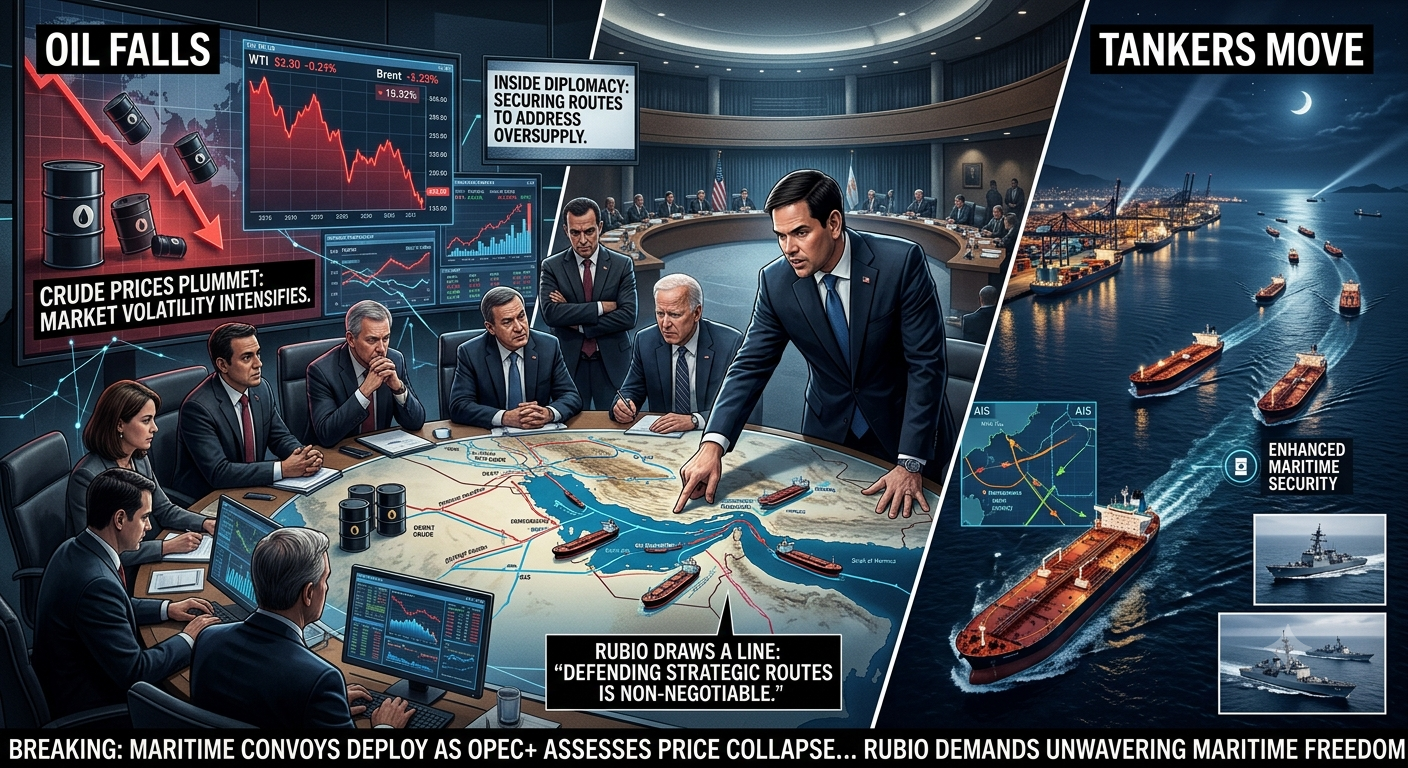
With Brent crude approaching pre-conflict levels, 70 vessels crossing the Strait of Hormuz in a single day and Secretary Rubio warning that Iranian transit tolls would trigger global “chaos,” the United States is navigating one of the most consequential weeks in modern energy diplomacy — and American consumers are still waiting to feel it at the pump.
ACT News — For the first time in nearly four months, the price of Brent crude oil — the international benchmark that shapes everything from airline ticket prices to the cost of groceries — has pulled back to within striking distance of the levels that prevailed before the onset of the high-complexity regional situation in the Middle East. The movement reflects a cautious but material shift in the flow of maritime traffic through the Strait of Hormuz, the narrow chokepoint through which roughly one-fifth of the world’s oil supply passes, following a memorandum of understanding signed between Washington and Tehran last week. Secretary of State Marco Rubio, currently on a diplomatic tour of Gulf states, is simultaneously working to reassure American allies in the region while drawing a firm line against any framework that would allow Iran to levy charges on commercial vessels using the waterway. The stakes for American households — and for global markets — could hardly be higher.
The numbers that matter
Brent Crude
$72.90
Down 1.3% Thursday morning · Pre-conflict level ~$70
US Crude (WTI)
$69.37
Down 1.4% · Briefly touched $70.34 Wednesday
Strait traffic
70 ships
Wednesday crossings · Up 105% day-over-day (Kpler)
Negotiation window
~60 days
Timeline set by US–Iran MOU for final agreement
Context: why the Strait of Hormuz matters to every American
The Strait of Hormuz is a sliver of water — at its narrowest, barely 21 miles wide — that separates the Arabian Peninsula from Iran and connects the Persian Gulf to the Gulf of Oman and the broader Indian Ocean. Its strategic importance is almost impossible to overstate: Saudi Arabia, the UAE, Kuwait, Iraq and Qatar all depend on it to export the oil and liquefied natural gas that powers much of the global economy. When traffic through the strait is disrupted — as it has been for the past several months amid the high-complexity geopolitical situation in the region — the effects are felt almost immediately in energy futures markets and, with a lag of several weeks, at the gas pump for American drivers.
The memorandum of understanding signed between Washington and Tehran last week established a 60-day negotiating window aimed at producing a durable, long-term agreement. It has already produced a measurable shift in shipping behavior. According to maritime intelligence firm Kpler, 70 vessels transited the Strait of Hormuz on Wednesday alone — a 105% increase compared to the previous day. Crucially, according to Kpler’s analysis, those vessels are increasingly opting for a southern route that tracks the Omani coastline rather than the northern passage that brings ships closer to Iranian territorial waters. Iran’s Islamic Revolutionary Guard Corps responded on Thursday by insisting that the only authorized route through the waterway is the one designated by Tehran — a signal that, despite the diplomatic progress, the operational ground rules remain actively contested.
“We still don’t know what normal is going to look like,” said Richard Mead, editor-in-chief of Lloyd’s List, describing shipping companies as operating in a “limbo period” until the final terms of the US–Iran negotiation are settled.
Rubio in the Gulf: the transit tolls debate
Secretary of State Marco Rubio arrived in Bahrain on Thursday for a meeting of the Gulf Cooperation Council, his first regional tour since the US–Iran memorandum was signed. His message to Gulf allies was deliberate and unambiguous on two fronts: that Washington would keep them fully informed and aligned on every decision made in the Iran negotiation process, and that the United States would not accept — under any final agreement — a framework that allows Iran to impose charges on commercial vessels transiting the Strait of Hormuz.
The issue of transit tolls has emerged as one of the most sensitive flashpoints in the broader diplomatic process. Iran has long maintained that it could impose fees on commercial shipping using the waterway on the grounds that the strait runs through waters it claims partial jurisdiction over. In a joint statement issued earlier this week, Iran and Oman — both of which have coastline along the strait — said they were developing a new joint mechanism to regulate maritime traffic that could carry “associated costs.” That language immediately drew a sharp response from the Trump administration.
Speaking at the GCC session in Bahrain, Rubio framed the tolls question as a matter of foundational international legal principle, not merely a bilateral dispute between Washington and Tehran. “International waterways do not belong to any nation-state,” he said, according to reporting confirmed by AFP and CBS News. “If we in fact accept that you can charge money to use an international waterway simply because it is near your territory, then that would spread around the world like a contagion.” Rubio added that while the United States genuinely wants a lasting agreement, it will not accept one “at any cost” — emphasizing that any deal must be verifiable and enforceable.
Oman’s Foreign Minister Sayyid Badr bin Hamad Al Busaidi provided diplomatic reinforcement for Washington’s position Thursday, stating publicly after the GCC session that any future arrangements involving the Strait of Hormuz “will not involve the imposition of transit fees.” Al Busaidi also reaffirmed Oman’s support for the US–Iran memorandum and underscored Muscat’s view of itself as a state with particular responsibility for ensuring the free flow of navigation through the strait — a role it has historically played as a backchannel between Washington and Tehran going back decades.
What the Senate did — and what it means
While Rubio was managing the diplomatic front in the Gulf, Capitol Hill delivered a result that strengthened the administration’s negotiating hand — if narrowly. The Senate voted 50 to 47 on Wednesday evening to reject a procedural motion that would have advanced a war powers resolution sponsored by Democratic Senator Tim Kaine and aimed at limiting President Trump’s authority to continue military operations against Iran without explicit Congressional approval. The measure was backed by most Senate Democrats, along with two Republican senators — Susan Collins of Maine and Lisa Murkowski of Alaska — who have consistently expressed reservations about the scope of executive war-making authority. Republican Senator Rand Paul voted present, while Democratic Senator John Fetterman of Pennsylvania crossed the aisle to vote against the measure.
The result is a significant, if not unqualified, win for the White House. Just one day earlier, four Republicans had joined Democrats in passing a separate House resolution with a similar objective — the first time in seven attempts that such a measure had advanced at all. The Senate defeat of the Kaine resolution means that, for now, the administration retains the operational flexibility it says it needs to negotiate from a position of strength with Tehran. Foreign policy analysts cited by multiple international outlets noted that Rubio’s ability to speak credibly to Gulf allies about Washington’s commitment and staying power depends in part on this domestic political stability.
Gas prices: why American drivers are still waiting
For the tens of millions of Americans who fill their tanks every week, the headline drop in crude oil prices raises an obvious question: when does relief show up at the gas station? The short answer, according to Chevron’s Chief Financial Officer Eimear Bonner, is: not yet. Speaking on CNBC’s European “Squawk Box” program Thursday morning, Bonner acknowledged that there is an inherent lag between movements in global crude prices and the retail gasoline prices that consumers actually pay. “There is a delay between oil prices declining and when that shows up at the pump,” she said.
That explanation has not satisfied President Trump, who publicly accused major energy companies of failing to pass crude price reductions through to American consumers and announced that he has ordered an investigation into the matter. Trump specifically named Chevron, ExxonMobil, Shell and BP, stating that gasoline prices “should be much lower at the pump.” The president’s remarks, made to reporters at the White House on Wednesday, represent an unusually direct public pressure campaign against some of the largest corporations in the American economy. Whether the investigation produces any regulatory action — or serves primarily as political signaling — remains to be seen, but the intervention underscores just how politically loaded the price of gasoline remains for the administration heading into the summer driving season.
Lebanon: a separate front requiring close monitoring
Away from the Hormuz negotiations, the Israeli military confirmed Thursday that a soldier was killed the previous day in southern Lebanon, where sporadic confrontations with Iran-backed Hezbollah have continued despite a cease-fire agreement. According to reporting confirmed by AFP, the soldier — identified as Sergeant-Major Basil Sweid, 32, serving as a driver — was killed when his vehicle overturned during an operational activity. Israeli military figures indicate that at least 37 soldiers and one civilian contractor have now been killed in southern Lebanon since active operations there recommenced. The development is a reminder that even as the US–Iran diplomatic process advances, the broader regional security architecture remains fragile and subject to rapid change.
What the 60-day window means for American markets
The memorandum of understanding between Washington and Tehran sets a roughly 60-day timeline for the two sides to finalize a comprehensive agreement. That window creates a specific set of conditions for energy markets, corporate planners and American households alike. In the near term, the partial resumption of Strait of Hormuz traffic is already pushing crude prices lower — a dynamic that, once it filters through to retail gasoline, could provide meaningful relief to American consumers dealing with elevated costs across most spending categories. The Brent benchmark has fallen roughly 3.8% in recent sessions and is now trading within a few dollars of the approximately $70 per barrel level that prevailed before the onset of the current geopolitical situation in late February.
However, the uncertainty that Lloyd’s List editor Richard Mead described as a “limbo period” is real and consequential. Shipping companies are making routing and insurance decisions under conditions that could change materially depending on how the Iran–Oman joint mechanism for Strait management is ultimately structured, whether the IRGC’s insistence on a single approved transit route is accommodated or resisted, and whether the 60-day negotiation produces an agreement or breaks down. Each of those outcomes carries significantly different implications for oil supply, energy prices, and by extension, the inflation picture facing the Federal Reserve as it weighs its next interest rate decisions.
For American investors with exposure to energy stocks, the near-term crude price decline creates pressure on producer revenues even as it benefits downstream consumers. The Trump administration’s investigation into major oil companies adds a layer of regulatory uncertainty to the sector at a moment when it is already navigating a rapidly shifting demand and supply picture. ACT News will continue monitoring all of these developments as they unfold across the remaining weeks of the negotiating window.
What comes next
The key markers to watch over the next 72 hours include: any further statements from the IRGC on permissible transit routes through the Strait and how commercial shipping operators respond; the outcome of Rubio’s remaining Gulf stops and whether any public communiqué from the GCC formally endorses the no-transit-fees principle; further crude price movements as tanker traffic data is updated daily; and any indication from the White House about the scope and timeline of the announced investigation into major energy company pricing practices. The situation in southern Lebanon also warrants continued monitoring given its potential to complicate the broader US–Iran diplomatic track.
ACT News will continue covering all developments across this story and their potential impact on American energy prices, financial markets and national security posture.