The Middle East entered a new and uncertain chapter on Thursday after reports emerged that the United States and Iran have agreed to establish a direct communication channel with Iran’s Islamic Revolutionary Guard Corps (IRGC), a development that could reshape regional diplomacy following months of conflict, military operations, and political negotiations.
By ACT News International Desk
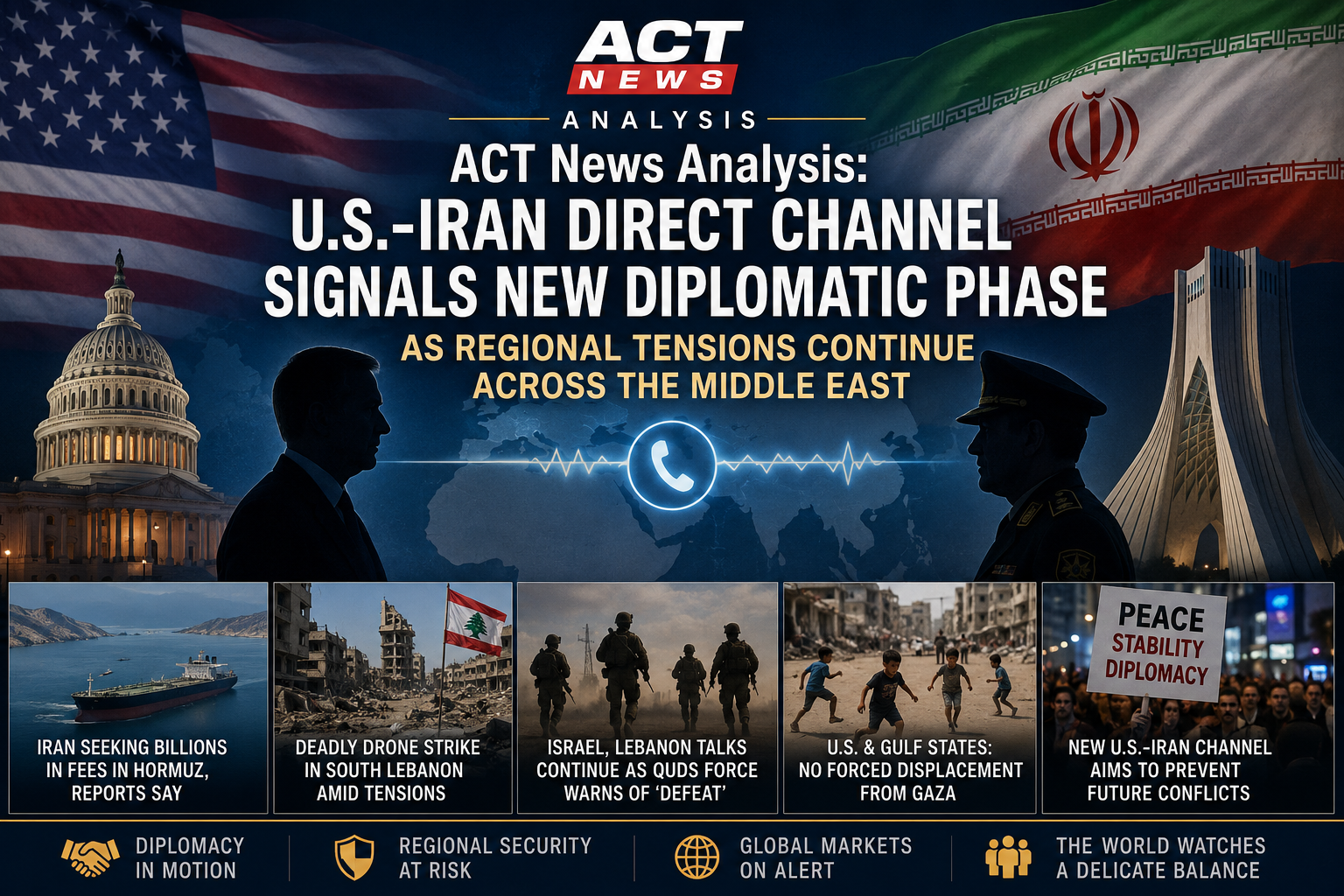
According to statements attributed to U.S. Vice President JD Vance, Washington and Tehran have agreed to create a direct mechanism aimed at reducing misunderstandings and resolving disputes before they escalate into larger confrontations. The proposed channel would reportedly allow American officials and representatives of the IRGC to communicate directly during periods of crisis, potentially lowering the risk of military escalation in one of the world’s most volatile regions.
The announcement comes only days after a fragile diplomatic understanding emerged between the United States and Iran following months of heightened tensions that drew in Israel, Lebanon, Gulf states, and international powers concerned about regional stability.
While details remain limited, analysts view the reported agreement as one of the most significant diplomatic developments between Washington and Tehran in recent years. The IRGC plays a central role in Iran’s military and strategic planning, making direct communication with the organization a potentially important tool for crisis management.
Growing Efforts to Prevent Regional Escalation
The reported communication channel arrives at a moment when governments throughout the Middle East are attempting to prevent further military escalation after a period marked by missile exchanges, drone attacks, and cross-border operations.
At the same time, diplomatic activity has accelerated across the region. The United States and several Gulf nations released a joint statement emphasizing support for regional stability, rejecting forced displacement of Palestinians from Gaza, and calling for continued efforts to address security threats posed by missile programs, drones, and armed proxy groups operating across the Middle East.
The statement also reiterated opposition to any attempts to impose fees or restrictions on international shipping through the Strait of Hormuz, one of the world’s most important maritime trade routes.
The strategic waterway remains a critical concern for global energy markets. Roughly one-fifth of the world’s oil supply passes through the narrow corridor connecting the Persian Gulf to international waters. Any disruption could have significant consequences for global energy prices and international trade.
Reports of New Iranian Plans for Hormuz
Adding another layer of complexity to the situation are reports suggesting that Iran may be exploring mechanisms to generate revenue through various service, security, or environmental fees connected to shipping activity in the Strait of Hormuz.
While no official policy has been formally announced, discussions surrounding the issue have already attracted international attention because of the waterway’s strategic importance.
Energy markets have reacted cautiously. Oil prices initially surged during the height of regional tensions but later retreated as shipping traffic continued and major disruptions failed to materialize. Market observers remain focused on whether future negotiations between Iran and international powers could affect freedom of navigation in the region.
Lebanon Remains a Key Flashpoint
Despite signs of diplomatic engagement between Washington and Tehran, tensions remain elevated along Israel’s northern border.
Reports from southern Lebanon indicate that multiple casualties occurred following a drone strike targeting a vehicle in the region. Security and medical sources attributed the strike to Israel, although official details remain limited.
The incident highlights the fragile security environment that continues to exist despite ongoing negotiations involving Israel, Lebanon, and international mediators.
Iranian officials have continued to issue strong statements regarding Israel’s military presence in southern Lebanon. Senior figures associated with Iran’s Quds Force have insisted that any long-term settlement must include a complete Israeli withdrawal from Lebanese territory.
Meanwhile, negotiations involving the United States, Israel, and Lebanon continue in an effort to establish a broader framework for stability along the border.
Diplomats involved in the discussions have emphasized that sustainable peace will require strengthening Lebanese state institutions while addressing the presence of armed groups operating outside government authority.
Gaza Remains Central to Regional Diplomacy
The future of Gaza continues to play a major role in regional discussions.
The joint statement issued by the United States and Gulf nations emphasized that no Palestinian should be forced to leave Gaza and that individuals who voluntarily depart must retain the right to return.
International efforts remain focused on reconstruction, humanitarian assistance, governance reforms, and long-term security arrangements.
Humanitarian organizations continue to warn about difficult conditions facing civilians in the territory. Meanwhile, international diplomats are working to balance immediate humanitarian needs with broader political and security objectives.
The issue remains one of the most sensitive aspects of ongoing regional negotiations, with multiple governments seeking a framework that can prevent renewed conflict while improving conditions for Gaza’s population.
Internal Debates Continue in Israel
Inside Israel, debates over military service, national security, and social integration remain highly visible.
Senior military officials have recently stressed the importance of maintaining a broad and inclusive force structure capable of meeting the country’s security challenges. Discussions have intensified regarding the role of women in combat units and the participation of various religious communities in military service.
These domestic debates are occurring as Israel continues to manage multiple security fronts simultaneously, including Gaza, Lebanon, Syria, and concerns related to Iran.
Military leaders have argued that maintaining cohesion across Israeli society remains essential for addressing long-term security challenges.
Regional Landscape Remains Uncertain
Across the broader Middle East, the emerging diplomatic channel between Washington and Tehran may represent an important attempt to reduce the likelihood of future crises. However, significant obstacles remain.
Questions surrounding Iran’s regional influence, missile programs, maritime security, proxy networks, and nuclear activities continue to dominate international discussions.
At the same time, unresolved issues involving Gaza, southern Lebanon, and broader Arab-Israeli relations remain sources of potential instability.
For now, regional governments appear focused on preventing a return to large-scale confrontation while exploring diplomatic alternatives. Whether the newly reported U.S.-Iran communication mechanism evolves into a durable confidence-building measure or remains a limited crisis-management tool will likely depend on developments in the coming months.
What is clear is that the Middle East remains in a period of rapid transformation. Diplomatic initiatives, security negotiations, and political realignments are unfolding simultaneously, creating both opportunities for de-escalation and risks of renewed confrontation.
As regional leaders navigate this complex environment, the establishment of a direct communication channel between the United States and Iran may become one of the most closely watched developments of 2026.
— ACT News